Unsupervised anomaly detection (UAD) offers a promising direction for fracture analysis where abnormal annotations are scarce, yet pelvic X-ray fracture detection remains exceptionally challenging due to overlapping anatomy, projection artifacts, and the inherently asymmetric presentation of fracture patterns.
We introduce SymmDiff, a symmetry-aware diffusion framework that embeds contralateral anatomical consistency directly into the generative correction process, mirroring the clinical practice of bilateral comparison. By pairing anatomically corresponding left–right regions and enforcing symmetry-consistent reconstruction during diffusion, SymmDiff generates a normal-corrected radiograph that selectively suppresses fracture-induced asymmetries while preserving global anatomical structure, enabling precise fracture localization through residual discrepancies between the input image and its symmetry-corrected counterpart.
Extensive evaluations on pelvic radiographs spanning subtle to severe fractures show that SymmDiff consistently outperforms existing anomaly-detection baselines, highlighting the effectiveness of symmetry-guided generative modeling for reliable fracture localization in clinical imaging.
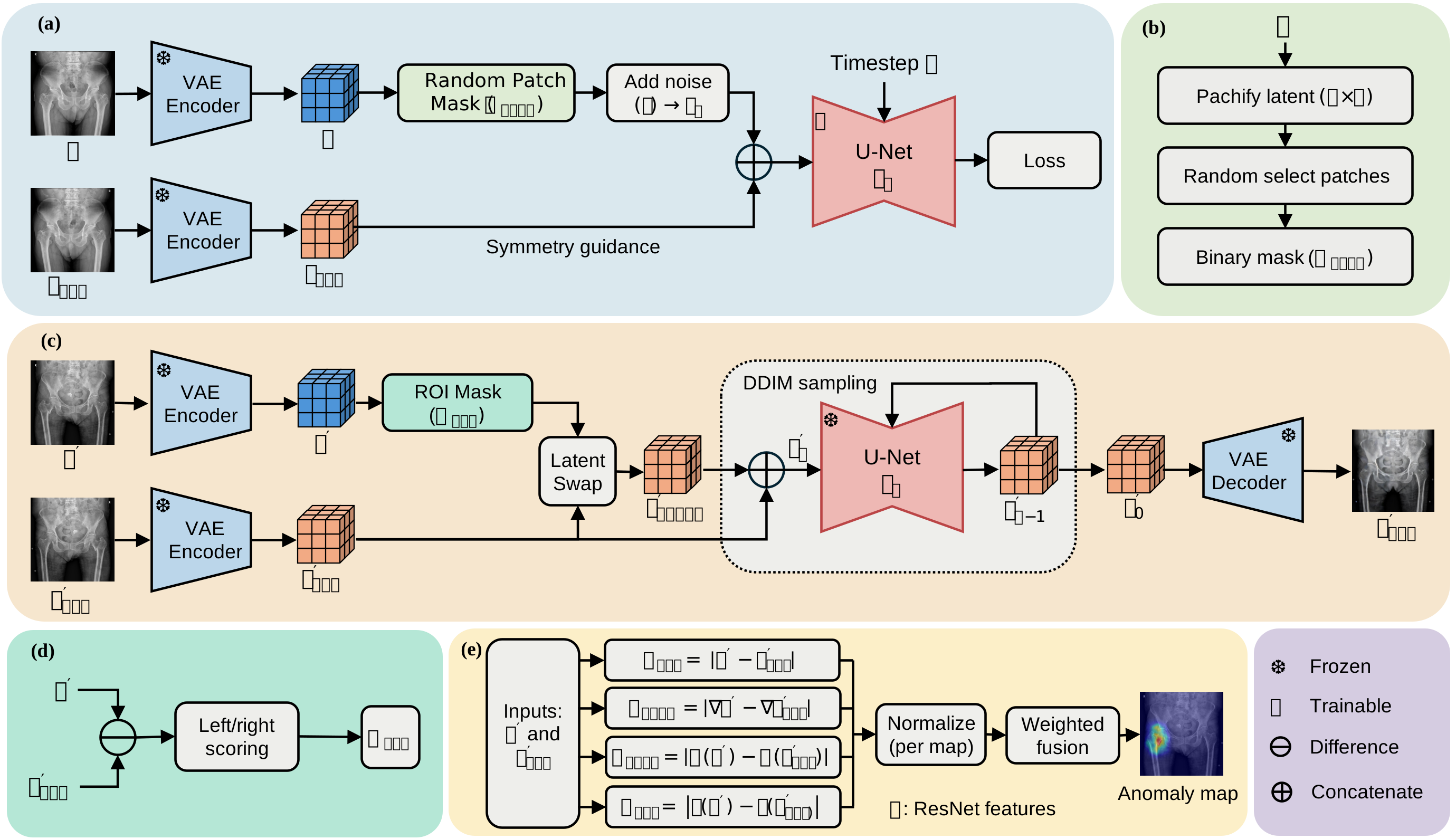
SymmDiff is a symmetry-guided latent diffusion framework. The input radiograph x and its horizontally flipped reference xsym are encoded by a pelvic-finetuned VAE to latents z, zsym. Because pelvic anatomy is bilaterally correspondent, conditioning on zsym reduces uncertainty (H(Z | R) < H(Z)) and provides a patient-specific structural anchor.
Training applies random patch masking to the noisy latent while channel-concatenating zsym as guidance, forcing the U-Net εθ to inpaint masked regions using bilateral context rather than memorizing local textures.
Inference derives a soft ROI mask from a side-to-side discrepancy score and initializes the reverse trajectory via a latent swap inside the ROI. Deterministic DDIM (η = 0) updates only inside the ROI, making the reverse process the identity outside it — imperfect mask estimation cannot induce global structural drift.
Multi-scale anomaly fusion combines four complementary residuals — pixel, gradient, perceptual (ResNet features), and latent — into a single anomaly map, capturing thin cortical breaks as well as broader deformities.
We evaluate on a retrospective Chosun University Hospital pelvic X-ray dataset (1,268 normal radiographs split 80/10/10 train/val/test; 534 abnormal cases reserved for evaluation, with pixel-level masks). SymmDiff consistently outperforms recent diffusion-based UAD baselines. Relative to the second-best method (THOR), image-level AUROC / AUPRC / F1max improve by +4.9 / +2.5 / +2.8, and pixel-level by +3.9 / +7.7 / +5.5.
| Method | Image-level | Pixel-level | ||||
|---|---|---|---|---|---|---|
| AUROC | AUPRC | F1max | AUROC | AUPRC | F1max | |
| DDPM | 84.5 | 83.0 | 80.1 | 76.5 | 23.3 | 24.6 |
| AnoDDPM | 87.5 | 85.4 | 83.0 | 79.5 | 26.1 | 27.8 |
| AutoDDPM | 89.0 | 85.9 | 84.2 | 80.6 | 27.6 | 27.0 |
| THOR | 89.3 | 89.1 | 88.3 | 84.5 | 36.2 | 37.2 |
| SymmDiff (ours) | 94.2 | 91.6 | 91.1 | 88.4 | 43.9 | 42.7 |
Table 1. Quantitative comparison on the Chosun University Hospital pelvic X-ray dataset. Best results in bold.
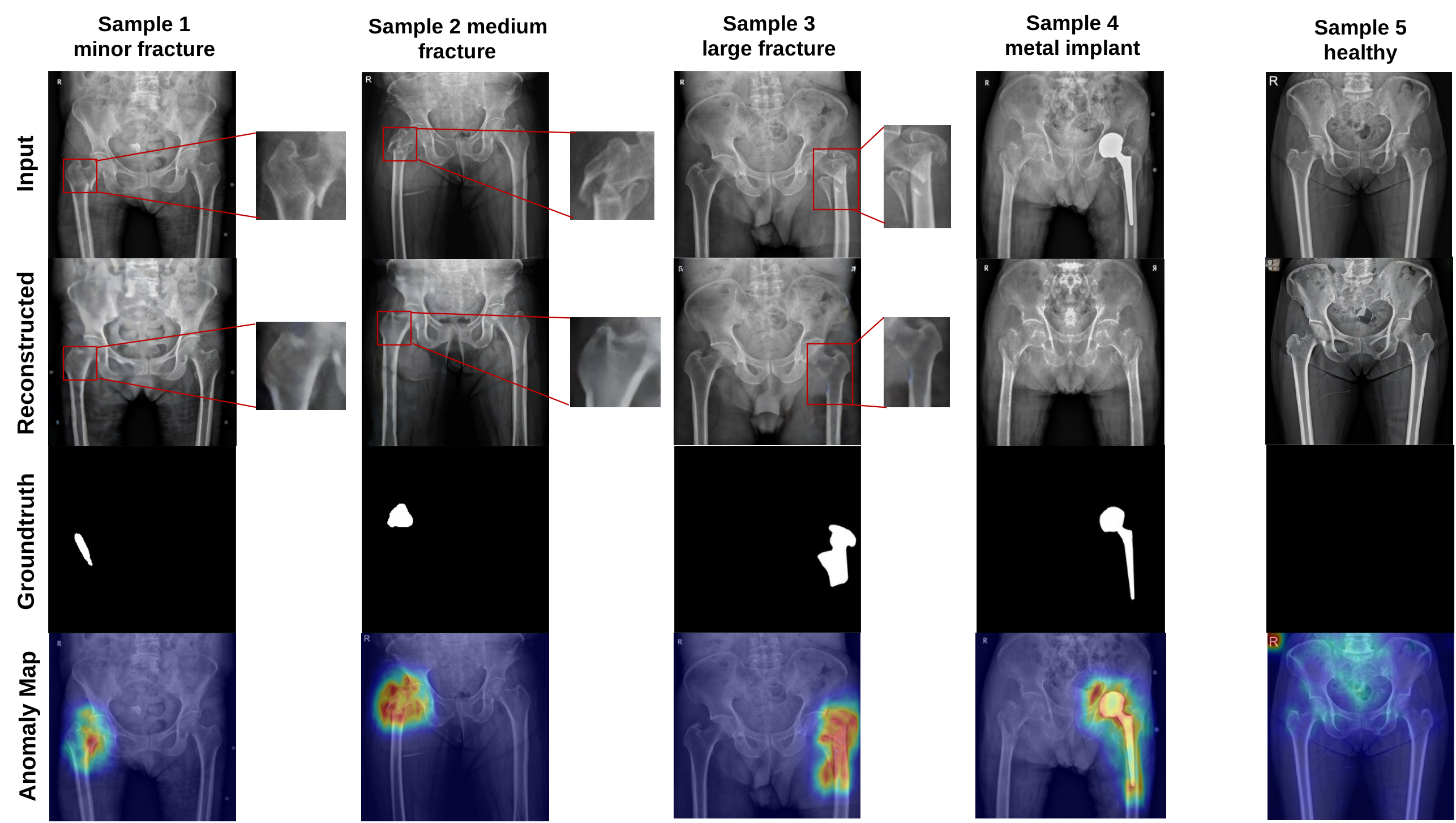
Across minor-to-large fractures (Samples 1–3), SymmDiff yields anatomically plausible reconstructions and localizes anomalies consistent with the masks. For the implant case (Sample 4), responses concentrate around the implant with minimal spillover; for the healthy case (Sample 5), activations remain low.
Figure 2. Qualitative localization results on pelvic X-rays. Columns show five different test samples. Rows: input radiograph, reconstructed corrected image, binary ground-truth mask, and predicted anomaly heatmap.
Each SymmDiff component contributes. Removing reference (symmetry) conditioning causes the largest drop, confirming the side-to-side prior as the strongest stabilizer; ROI-constrained denoising prevents global drift, and multi-scale fusion is necessary for thin fractures that are weak in raw intensity residuals.
| Variant | Image-level | Pixel-level | ||||
|---|---|---|---|---|---|---|
| AUROC | AUPRC | F1max | AUROC | AUPRC | F1max | |
| SymmDiff (full) | 94.2 | 91.6 | 91.1 | 88.4 | 43.9 | 42.7 |
| w/o reference conditioning | 89.4 | 88.2 | 86.2 | 79.9 | 32.4 | 30.6 |
| w/o random patch masking | 93.7 | 90.8 | 89.7 | 86.3 | 36.0 | 35.7 |
| w/o ROI-constrained denoising | 91.8 | 90.3 | 89.8 | 83.2 | 35.7 | 35.1 |
| w/o latent swap | 92.6 | 90.5 | 89.8 | 84.5 | 38.5 | 37.7 |
| w/o multi-scale fusion (pixel only) | 93.9 | 91.2 | 90.7 | 86.6 | 36.8 | 35.9 |
Table 2. Ablation study of SymmDiff components on the Chosun University Hospital pelvic X-ray dataset.
Insight 1. Contralateral consistency is a strong inductive bias for pelvic UAD — it stabilizes "normality" where global density alone fails.
Insight 2. Coupling symmetry into the reverse trajectory — not post-hoc — prevents anatomical drift during iterative denoising.
Insight 3. ROI-gated updates with identity-outside-mask make the pipeline robust to imperfect contralateral references.
Insight 4. Multi-scale residual fusion is essential for thin cortical breaks that vanish in any single residual view.
@inproceedings{rahman2026symmdiff,
title = {SymmDiff: Symmetry-Guided Diffusion for Fracture
Localization in Pelvic Radiographs},
author = {Rahman, Abdul and Ghafoor, Afnan and Lee, Bumshik},
booktitle = {Medical Image Computing and Computer-Assisted
Intervention -- MICCAI 2026},
year = {2026},
publisher = {Springer},
}